For years, we’ve believed that one of the most effective ways to accelerate clean energy adoption isn’t simply through new technology or financial incentives – it’s through people.
When neighbors share their experiences. When trusted local volunteers answer questions. When communities create spaces for learning and encouragement. Those conversations help turn curiosity into action. Now, new independent research provides evidence that reinforces that belief.
Looking at the Data
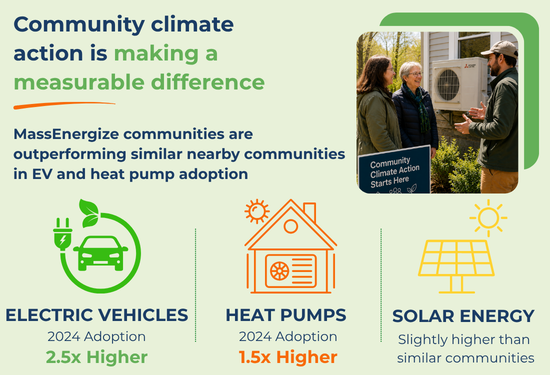
Professor Zana Cranmer of Bentley University recently conducted an independent analysis of residential clean energy adoption across ten MassEnergize communities, reviewing 2023 and 2024 data on electric vehicles (EVs), heat pumps, and solar energy. The study examined communities including Acton, Ashland, Concord, Framingham, Harvard, Natick, Stow, Sudbury, and Wayland, comparing clean energy adoption with similar nearby communities across Massachusetts.
The findings were encouraging. MassEnergize communities consistently showed:
- 2.5% higher electric vehicle adoption
- 1.5% higher heat pump adoption
Both differences were statistically significant. Importantly, the analysis also explored factors that are known to influence clean energy adoption – including household income, work-from-home rates, and access to natural gas infrastructure. While these factors certainly matter, they did not fully explain the higher adoption rates observed in MassEnergize communities.
Community Matters
No single organization can claim responsibility for a community’s clean energy transition and many factors influence whether someone decides to purchase an EV, install a heat pump, or invest in solar. But the research reinforces something we’ve seen firsthand in communities across Massachusetts. People are far more likely to explore clean energy solutions when they hear about them from someone they trust.
- A neighbor who installed a heat pump last winter.
- A volunteer who explains available rebates.
- A community event where residents can ask honest questions without feeling pressured.
Climate action spreads through relationships as much as it spreads through technology. As Ellen Tohn, longtime community leader in Wayland, explains:
“People are much more likely to explore clean energy solutions when their neighbors and trusted community members suggest technologies like heat pumps, solar and EVs make good sense.”
Turning Data into Action
Professor Cranmer also collaborated with MassEnergize, the Massachusetts Climate Action Network (MCAN), and Green Energy Consumers Alliance to develop the Massachusetts Climate Goals Tracker – an online tool that helps municipalities monitor local clean energy adoption and understand the sources of greenhouse gas emissions in their communities. The tracker gives local leaders access to meaningful data that can help prioritize programs, measure progress, and engage residents in achieving local climate goals.
The Bigger Opportunity
Massachusetts has made tremendous progress in developing clean energy technologies and expanding financial incentives. But technology alone doesn’t create change. People do.
If we’re serious about accelerating the clean energy transition, we must invest not only in innovation, but also in the community networks that help people understand new technologies, build confidence, and take the next step. Community engagement may not always receive the same attention as new technology or public policy. But if this research tells us anything, it’s that it deserves to be considered one of our most important climate solutions.
Explore the Massachusetts Climate Goals Tracker to see clean energy adoption and greenhouse gas emissions for your community, and discover how local engagement is helping accelerate climate action across Massachusetts.